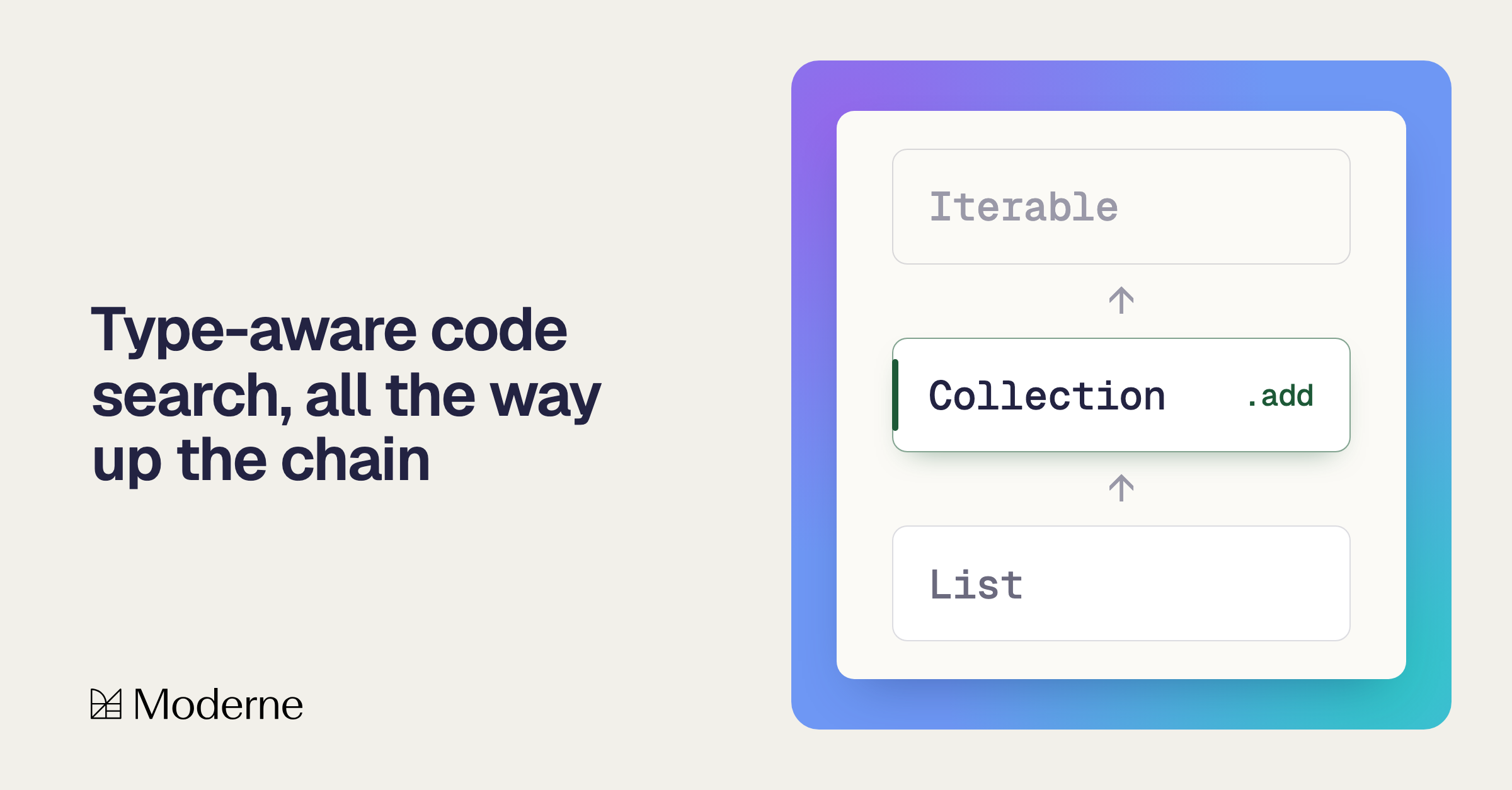
Moderne gives coding agents deterministic tools
Contents
- One command gives your agent a full semantic toolbox.
- What does the Moderne MCP server give a coding agent?
- How is MCP-based code search different from grep for an agent?
- Let the recipes do the work.
- Can coding agents run OpenRewrite recipes?
- The server builds its index and LST in the background.
- Move the work from GPU to CPU.
Think about how a coding agent navigates your codebase. It uses grep to find patterns. It opens files. It reads them to figure out if what it found is actually relevant. Then it does it again and again and again.
Text search and file reading are the tools agents reach for most, and for a lot of everyday tasks they’re fine. But when the work requires understanding code semantics, like finding every usage of a deprecated API through inheritance, tracing a dependency graph, or migrating a framework across hundreds of files, the agent compensates for the limits of its toolbox with brute force. Grep, open, read, reason, repeat. Every cycle in that loop costs time and tokens, and the costs compound fast across a session.
A smarter model doesn’t get you out of that loop, because it’s still working with the same tools.
We’ve written about agents as the primary consumers of dev tools and the opportunity to move work from GPU to CPU wherever possible. The Moderne CLI for agents includes a local MCP server that puts better tools inside the repository the agent is working in.
Moderne’s AI Agent Tools: Deterministic, Accurate, and Faster Reasoning at Scale
▶ Watch on YouTube
One command gives your agent a full semantic toolbox.
The Moderne CLI includes an MCP server that runs locally alongside your coding agent, giving it direct access to tools backed by a semantic model of your code. One command installs it:
mod config agent-tools installThe CLI auto-detects your agent (Claude Code, Cursor, Windsurf, GitHub Copilot, Sourcegraph Amp, OpenAI Codex, and OpenCode) and wires in the right configuration. The next time you start an agent session inside a git repository, a local MCP server process starts in the background and a new set of tools becomes available. The server runs as a subprocess of the agent itself, communicating over stdin/stdout, and source code never leaves the machine. (The security and architecture documentation covers network behavior and telemetry in detail.) It exposes the same operations already available through the mod CLI, just in a structured form the agent can call directly. Those tools cover two key things agents spend the most time (and tokens) on: searching the codebase and making changes to it.
What does the Moderne MCP server give a coding agent?
Deterministic tools built on the Lossless Semantic Tree: indexed and type-aware code search, codebase-wide renames, and OpenRewrite recipe execution. An agent that calls them instead of grepping and reading files spends its tokens on the change rather than on figuring out where the change goes.
Trigrep searches code instead of text.
If you watch an agent work, it searches a lot more than you’d expect. Not just when you ask it to find something, but constantly. It’s frequently checking assumptions, looking for usages, and figuring out what’s connected to what. The default tool for all of this is grep, and it works fine for small amounts of code, but every broad match means another file the agent has to open and read to confirm relevance. For large codebases, like the 5 billion lines of code or large monorepos we see at our customers, grep and similar searches simply don’t scale.
Moderne Trigrep changes that equation. It’s a trigram-indexed search that operates on a pre-built index rather than scanning files. Through the local MCP server, it’s exposed as two tools: trigrep_search for text, regex, and filtered queries with support for Zoekt-based symbol search, and trigrep_structural_search for Comby-style pattern matching across multi-token code structures. Queries return in milliseconds regardless of repository size.
Speed matters, but the more important improvement is precision. Because Trigrep’s index is built from Moderne’s Lossless Semantic Trees (LSTs) rather than raw source files, it carries structural metadata that a plain text index doesn’t have. The query syntax will look familiar to agents already trained on commonly used code search tools, so there’s no new language to learn, but the filters go further.
With extends:Person, the agent gets back only the classes that actually extend Person, not every file that mentions the word. Class inheritance, method visibility, return types, and thrown exceptions are all resolved from the type system in the LST. Without these filters, the agent has to open each matching file and read enough context to verify whether the match is structurally what it’s looking for.
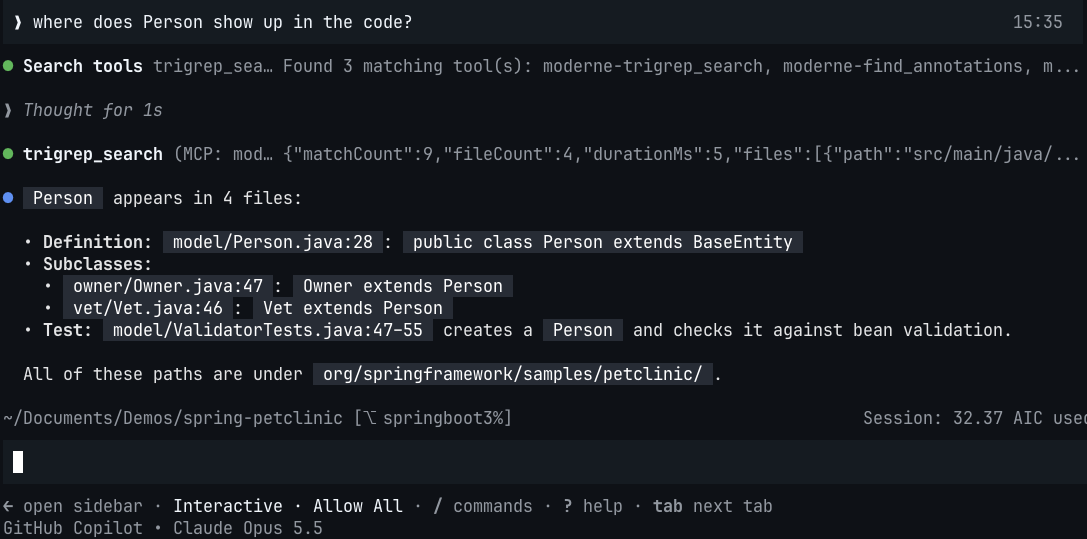
Semantic filters cut out most of those follow-on reads by giving the agent results it can act on directly.
How is MCP-based code search different from grep for an agent?
Grep matches text, so the agent has to open each result to check whether it’s the code it wants. The Moderne MCP tools resolve types and symbols from the LST, so the agent gets back the actual call sites, implementations, and subclasses, without the false positives to read through.
Let the recipes do the work.
Search gets agents oriented, but the work that really burns through time and tokens is transformation. When the agent has to figure out a migration or refactoring from scratch, the process looks the same every time: read the files, understand the pattern, write the change, handle edge cases, file by file. That works for one-off changes, but it doesn’t scale when the same change needs to happen consistently across hundreds of files in a repository.
Moderne serves up deterministic recipes that provide semantically correct transformations. The OpenRewrite open source community contributes and maintains thousands of them, and Moderne’s own catalog adds thousands more that have been hardened over time across real enterprise codebases. The local MCP server gives agents direct access to this combined catalog through a handful of tools:
-
edit_codefinds a curated recipe that changes code across the repository, andanalyze_codefinds one that analyzes code without changing it. -
learn_reciperetrieves the full details, including description, configurable options, and data table schemas. -
run_recipeexecutes a recipe against the repository. No AI is involved in recipe execution because recipes are deterministic, producing the same result every time given the same input. -
query_datatableruns SQL against the data tables a recipe produces, so the agent can summarize the results instead of reading every row.
In testing, an agent doing a Java 25 migration without Moderne’s tools burned through more than 61 million tokens in 45 minutes and finished only about a quarter of the work. The agent was reading files, reasoning about each change, writing transformations, and missing edge cases. With run_recipe, the same migration finished in about 3 minutes using roughly 30,000 tokens. The recipe already encoded every transformation needed and applied them all deterministically. The agent spent its budget on the parts that actually required reasoning.
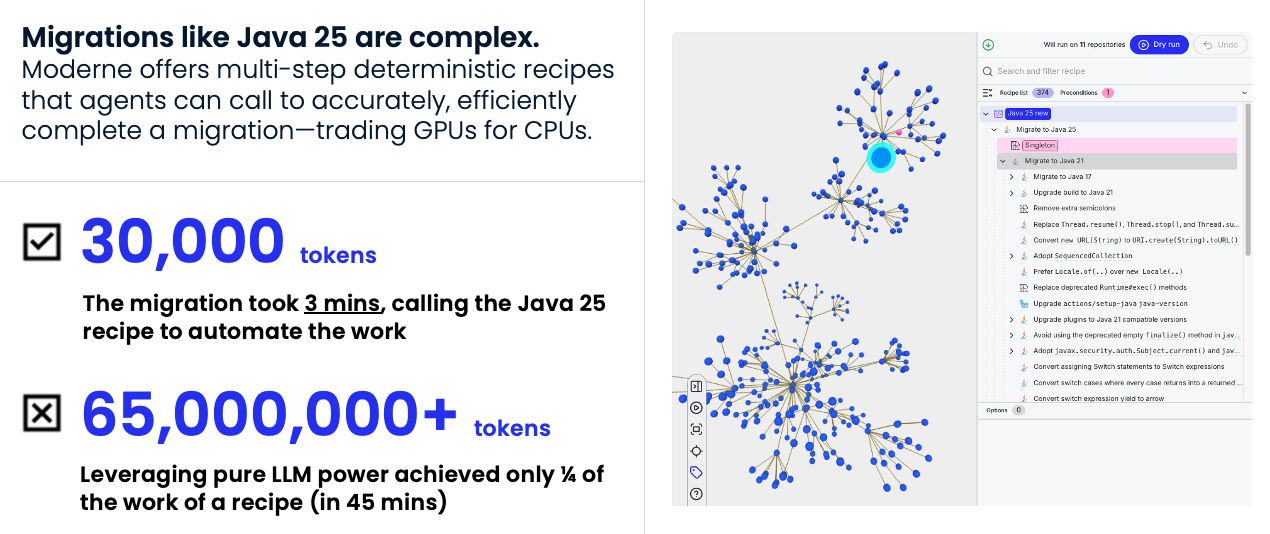
The local MCP server also exposes some commonly used recipes as direct tool calls, so the agent doesn’t need to go through the full find, learn, and run cycle for frequent operations. change_type renames or moves a type across the entire codebase, updating every import, reference, and declaration. It’s what an IDE rename does, but available to the agent across the whole repo. change_method_name does the same for methods. pattern_replace compiles and runs a short pattern in Moderne’s Kotlin recipe DSL (a rewrite {x} to {y} block) for structural before-and-after changes. (This tool was added specifically because an agent asked for this functionality.)
When no recipe exists for the job, agents can write their own, turning a one-time inference cost into a reusable tool. And when the same change needs to land across many repositories, the remote MCP server (in beta) runs recipes against the repositories already in your Moderne tenant, or you can run them locally with mod <agent> chat.
Can coding agents run OpenRewrite recipes?
Yes. Through the Moderne MCP server or using the CLI, an agent can find a recipe, check its options, run it, and query the data tables it produces. The agent decides what to change and the recipe makes the edits deterministically, which is how a Java 25 migration dropped from more than 61 million tokens to about 30,000.
The server builds its index and LST in the background.
Once it’s running, the server immediately begins building two things in the background: the Trigrep index and a Lossless Semantic Tree. Both are built and stored locally.
The latest generation of the LST format, LSTv3, was designed specifically with this kind of agent-driven workflow in mind. Two capabilities matter most here:
-
Incremental compilation means that after the LST has been built, when the agent edits a file, only that file needs to be recompiled into the semantic model. The LST stays current as the code changes without a full rebuild. The agent edits, the model updates, and the next semantic query reflects the change.
-
Random file access means the server can jump directly to an individual file’s semantic representation on demand, without deserializing the entire repository. If the agent needs to understand a specific class, the tool can load just that file’s model rather than processing everything.
If you want a human-readable view of the same information that the local MCP server exposes, there is an optional tool browser included with the CLI. Turn it on with mod config features agent-tools tray --enabled, and (on Mac) a system tray icon opens a browser-based dashboard showing project cards with build status, file counts, and tool call metrics, along with build logs and parse timing details. You can also test MCP tool calls directly from this browser dashboard. It’s a useful window into what the agent has access to and how it’s using it.

Move the work from GPU to CPU.
There’s a pattern running through everything here: the work that can be done deterministically should be done deterministically, so the agent can spend its inference budget on work that actually requires reasoning.
Pre-built indexes replace grep-and-read loops. Deterministic recipes replace hand-written transformations. Semantic filters replace file-read verification. Incremental LST builds replace full recompilation. Each of these swaps GPU for CPU as much as possible, trading expensive, probabilistic inference for fast, deterministic computation.
Moderne Prethink extends this same principle to codebase context. Instead of spending tokens at the start of every session while the agent explores your code to understand architecture, dependencies, and conventions, Prethink pre-computes that context using static analysis. The context lives alongside your code, can be versioned with it, and is made available to any agent on any machine without additional setup. No decisions about where to store it or how to sync it. It’s stored in the repo, available when the agent starts, and can be dynamically updated as code changes.
This matters even more for code quality. Agents work well in well-structured codebases where patterns are consistent and conventions are clear. They struggle in codebases with accumulated inconsistencies, mixed patterns, and unresolved tech debt. Prethink’s code quality metrics give the agent structured feedback about the state of the code it’s working in, like complexity hotspots and consistency gaps. Instead of generating code that looks fine in isolation but doesn’t match the surrounding codebase, the agent has a signal about what “good” looks like in this specific repo and can adjust accordingly.
As agent usage scales across more sessions, more repositories, and more engineers, the cost difference between the CPU and GPU approaches compounds. The organizations that get ahead of this will be the ones that give their agents better tools, so the model can focus on the work that actually needs it.
Originally published